S35 Particle Detectors and Accelerators
Accelerator Physics by Professor Adrian Oeftiger

Lecture 1: Introduction to Accelerators
Run this notebook online!
Interact and run this jupyter notebook online:

Also find this lecture rendered as HTML slides on github $\nearrow$ along with the source repository $\nearrow$.
Today!
- Intro to Accelerators
- Accelerator Types
- Facilities and Applications
- Time Scales
A 2010 report titled Accelerators for Americas Future on the usefulness of particle accelerators:
"A beam of the right particles with the right energy at the right intensity can
- shrink a tumor,
- produce cleaner energy,
- spot suspicious cargo,
- make a better radial tire,
- clean up dirty drinking water,
- map a protein,
- study a nuclear explosion,
- design a new drug,
- make a heat-resistant automotive cable,
- diagnose a disease,
- reduce nuclear waste,
- detect an art forgery,
- implant ions in a semiconductor,
- prospect for oil,
- date an archaeological find,
- package a Thanksgiving turkey,
or... discover the secrets of the universe."
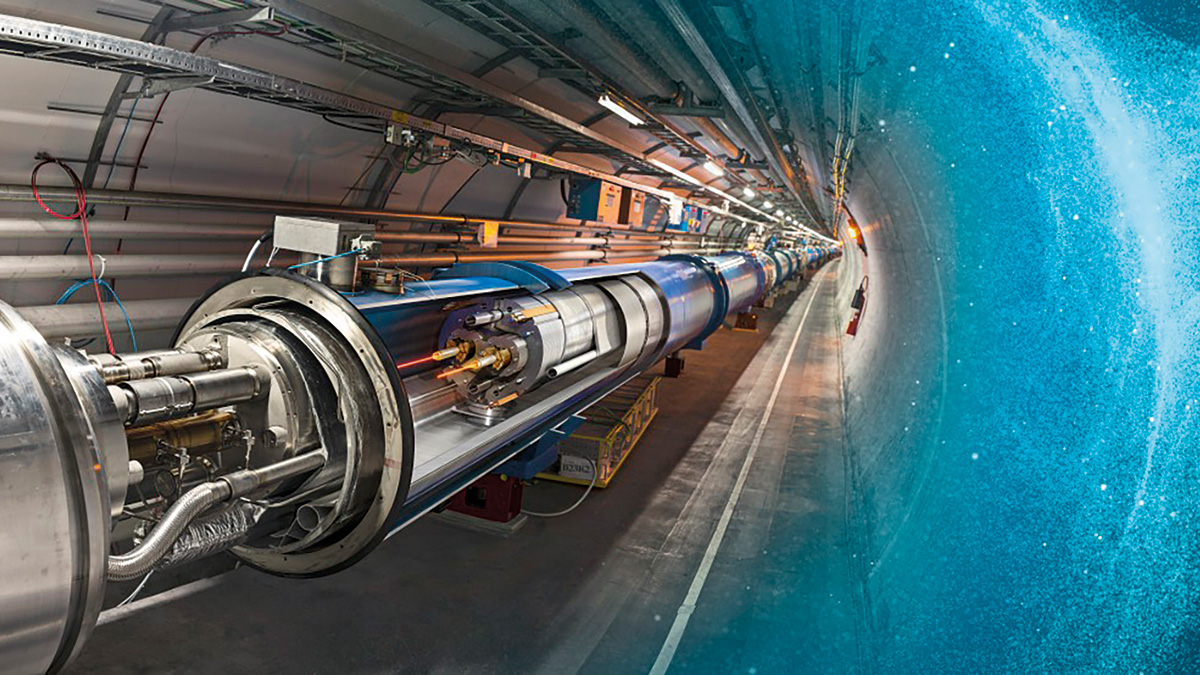
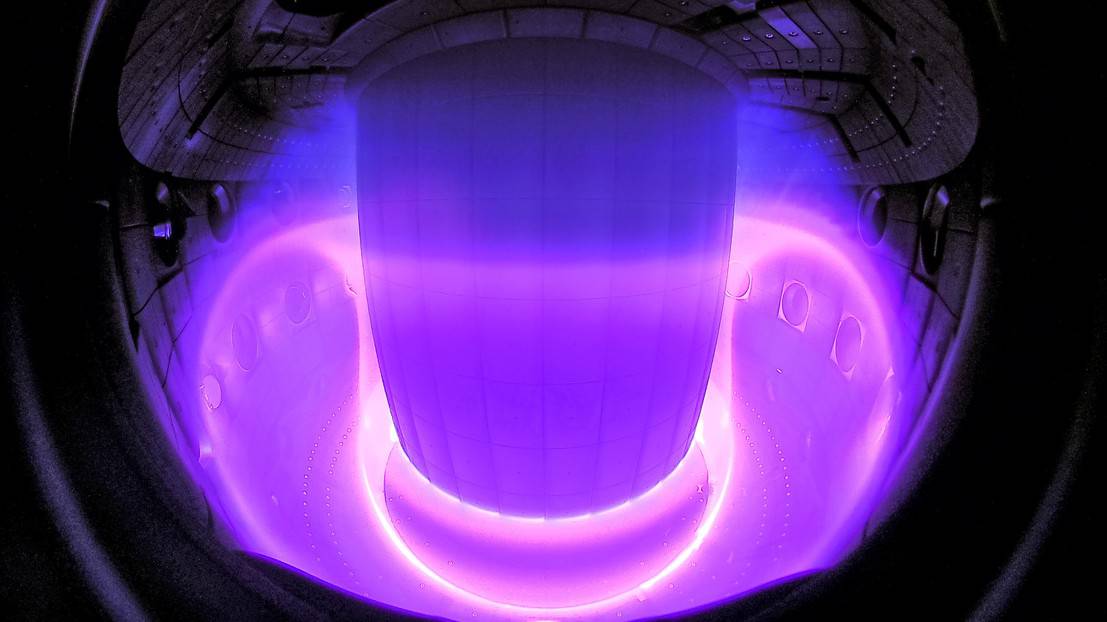
What fields make a "particle accelerator"?
$$\begin{matrix}\,\text{beam self fields} &>& \text{external applied fields} &\text{(plasma)} \\ \text{beam self fields} &\ll& \text{external applied fields}& \text{(accelerator)}\end{matrix}$$
$\implies$ perturbation technique applicable to higher-energy accelerators:
$$\begin{cases} \text{unperturbed motion} &= \text{external fields} \\ \text{perturbation} &= \text{self fields} \end{cases}$$
How many accelerators exist worldwide?
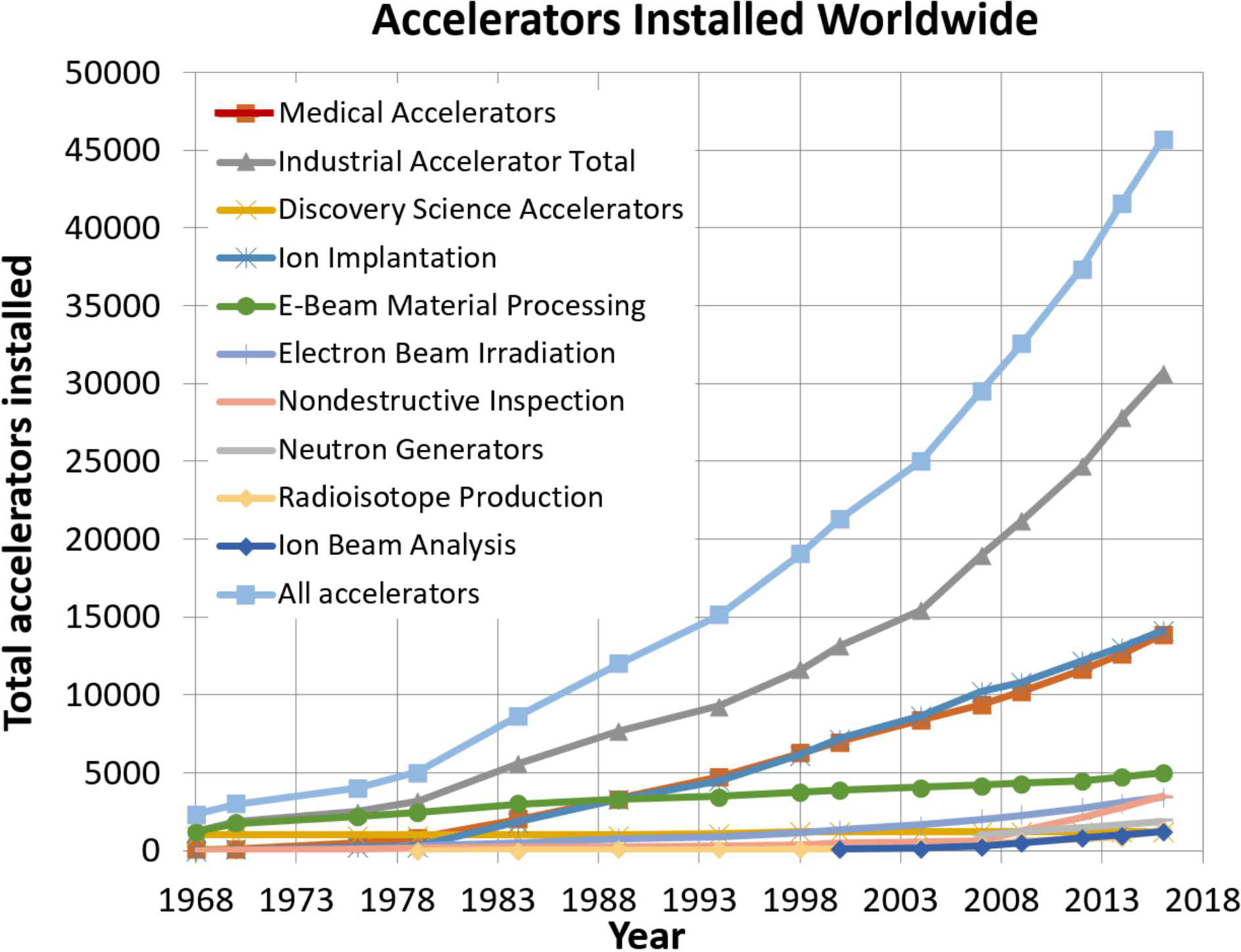
B.L. Doyle et al., "The Future of Industrial Accelerators and Applications" (2019)
What are accelerators used for?
| Field | Application | Worldwide (%) |
|---|---|---|
| Research | 7.6% | |
| Particle Physics | 0.2% | |
| Nuclear Physics, solid state, materials | 0.2–0.9% | |
| Neutron generators ... | 6.5% | |
| Medical Applications | 33.1% | |
| Hadron therapy | 0.2% | |
| Radioisotope production | 3.2% | |
| Radiotherapy Linacs ... | 29.7% | |
| Industrial Applications | <60% | |
| Ion implantation | 34.0% | |
| E-beam material processing | 10.8% | |
| Non-destructive inspection | 7.5% | |
| E-beam irradiation ... | 6.9% |
Overview: beam control in accelerators
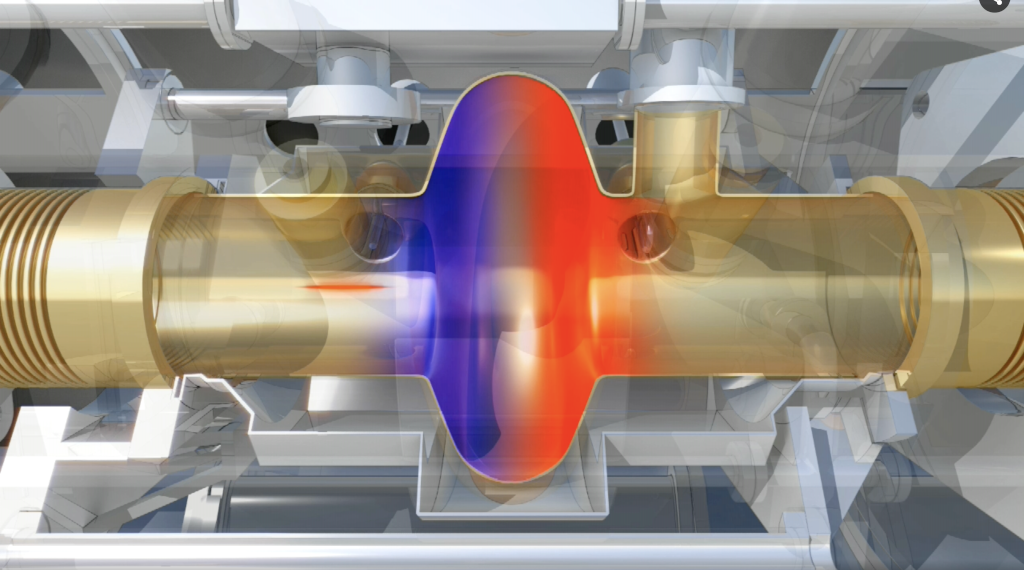
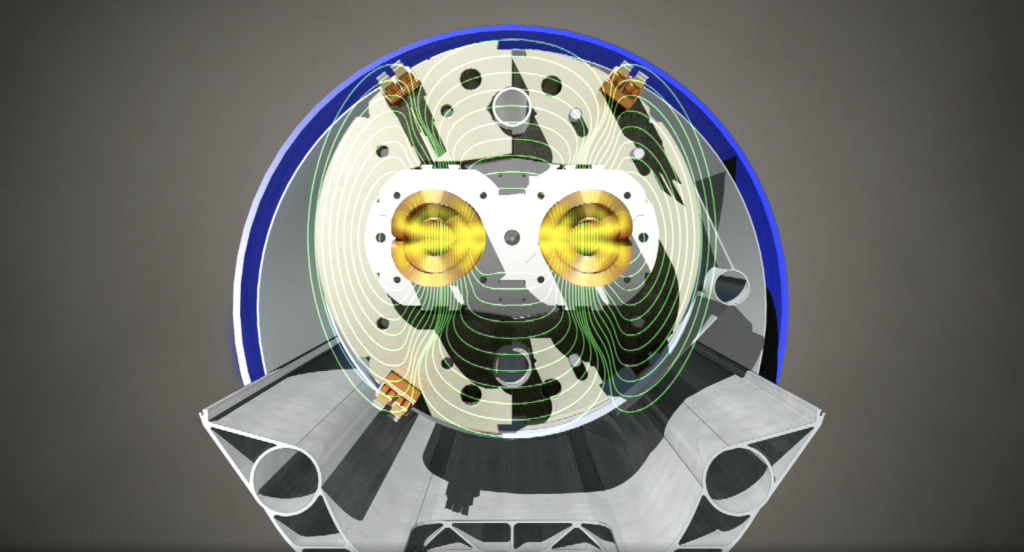
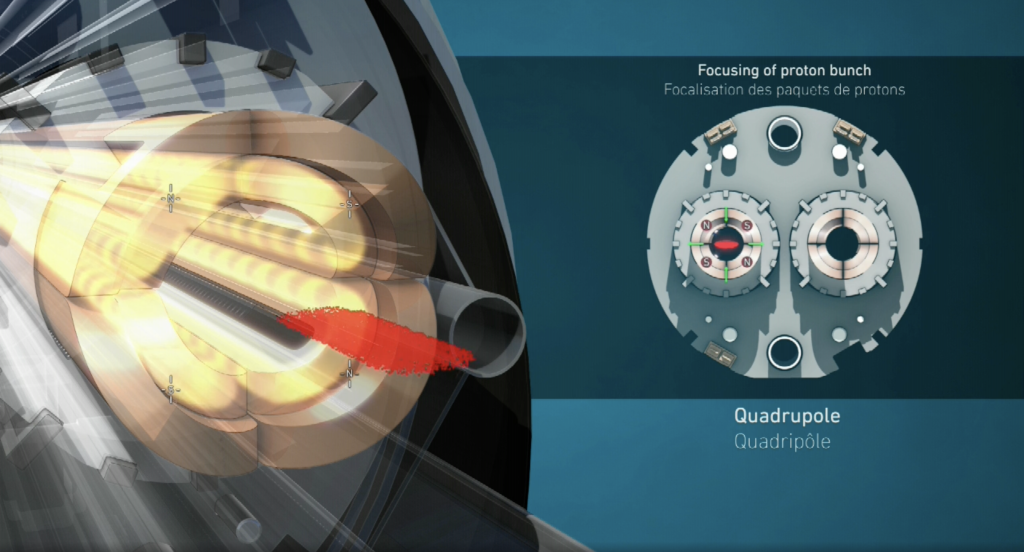
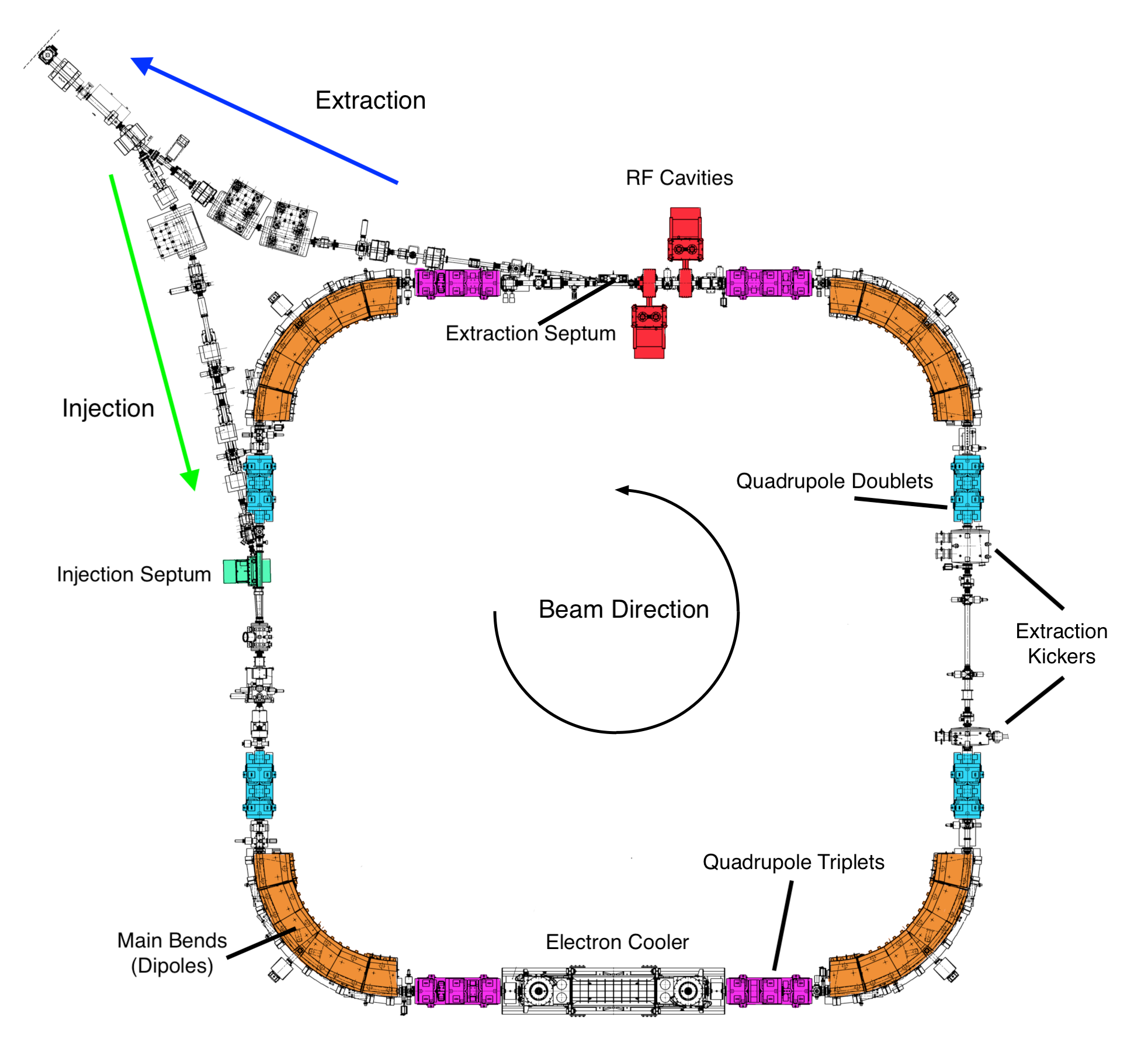
3 key beamline elements, exploiting Lorentz force:
$$F=q(\mathbf{E}+\mathbf{v}\times\mathbf{B})$$
- radio-frequency (rf) cavities for bunching and acceleration
- dipole magnets for steering
- quadrupole magnets for (transverse) focusing
$\implies$ enforce oscillations to contain particles!
(Physicists like their harmonic oscillators...)
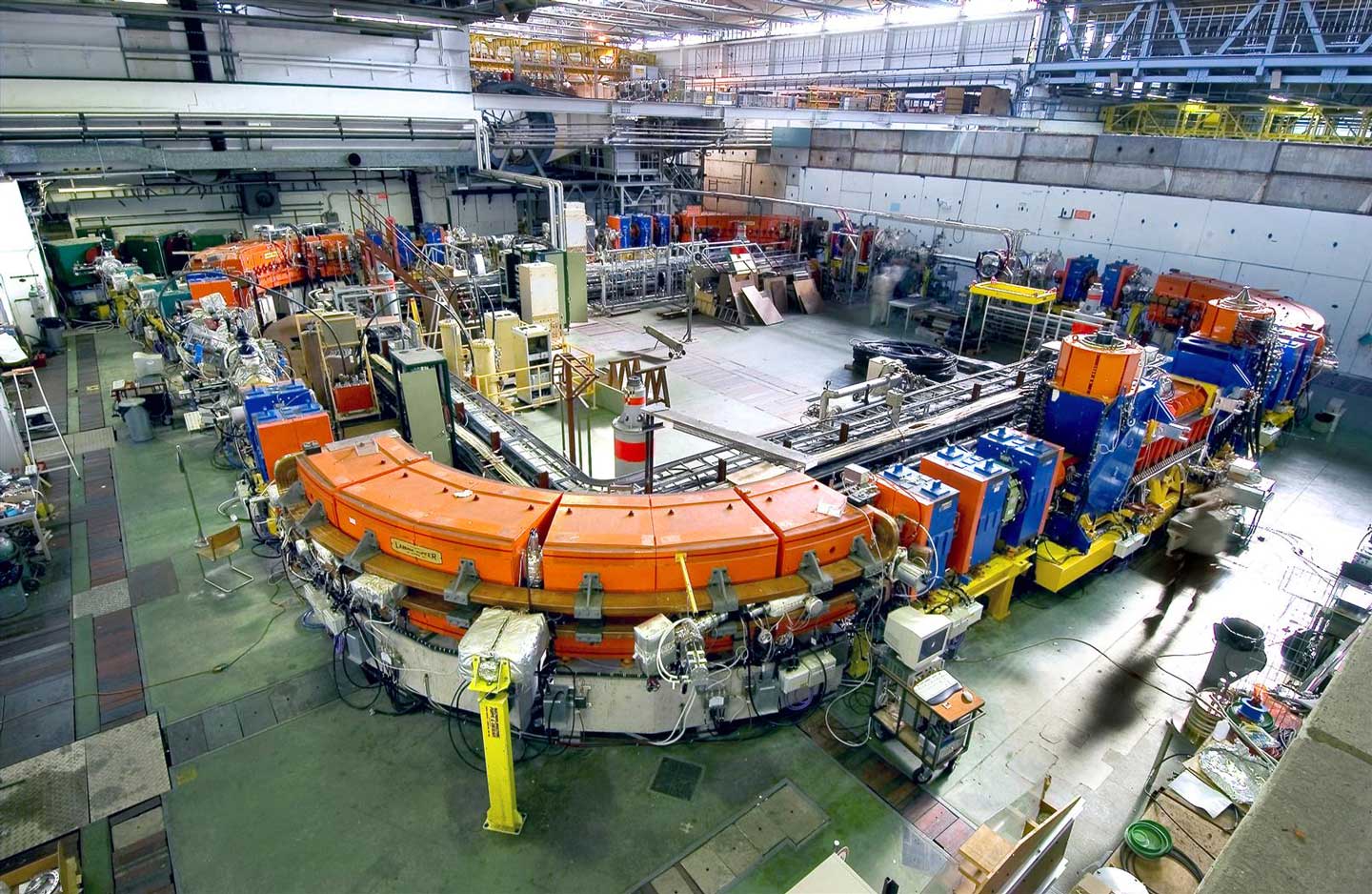
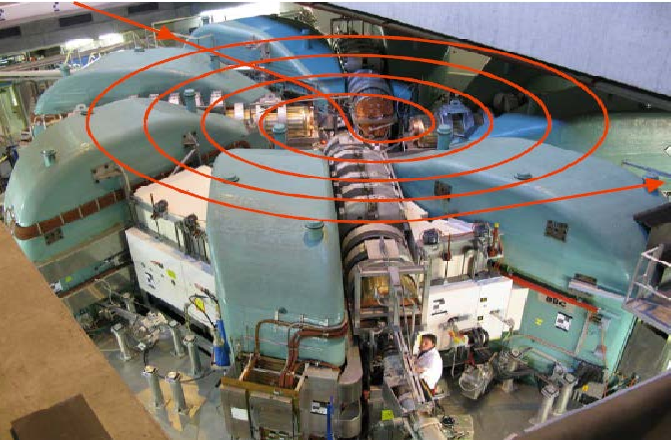
Circular accelerator: spot the 3 key beamline elements
One "Electron Volt"
1 eV $=$ gained kinetic energy of particle with elementary charge after traversing 1 V potential difference
Wave Lengths for Probing Structures
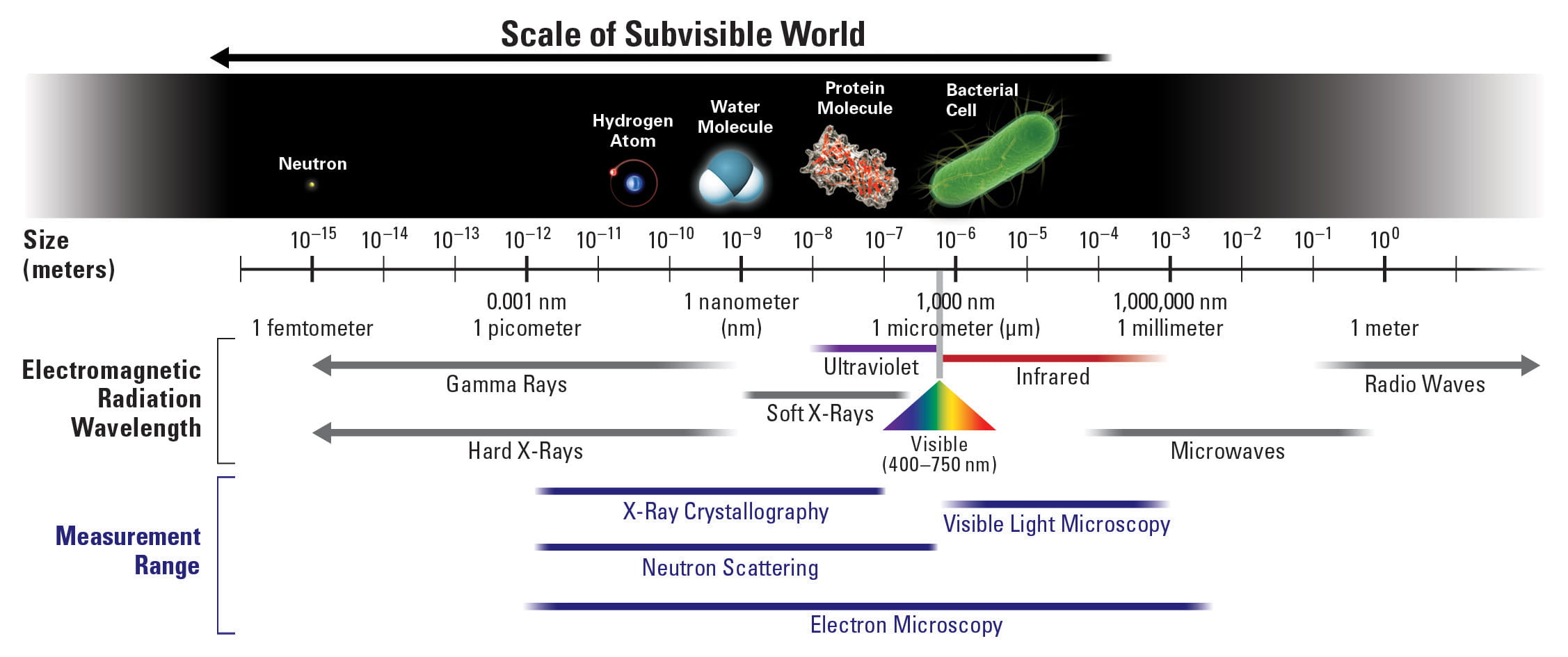
Energy Scales
$\implies$ Use photons just as well as electrons or protons/neutrons/ions (matter waves!) to probe
from scipy.constants import h, c, e, m_n
lambda_ = 1e-10 # wave length in m
mass = m_n # mass (e.g. neutron, m_n)
p = (h / lambda_ / (e/c)) # momentum in eV/c
Ekin = ((p**2 * c**2 + mass**2 * c**4) - mass * c**2 ) * e
f"momentum p={p:.2e} eV/c, energy Ekin={Ekin:.2e} eV"
'momentum p=1.24e+04 eV/c, energy Ekin=2.21e+06 eV'
Major accelerator types
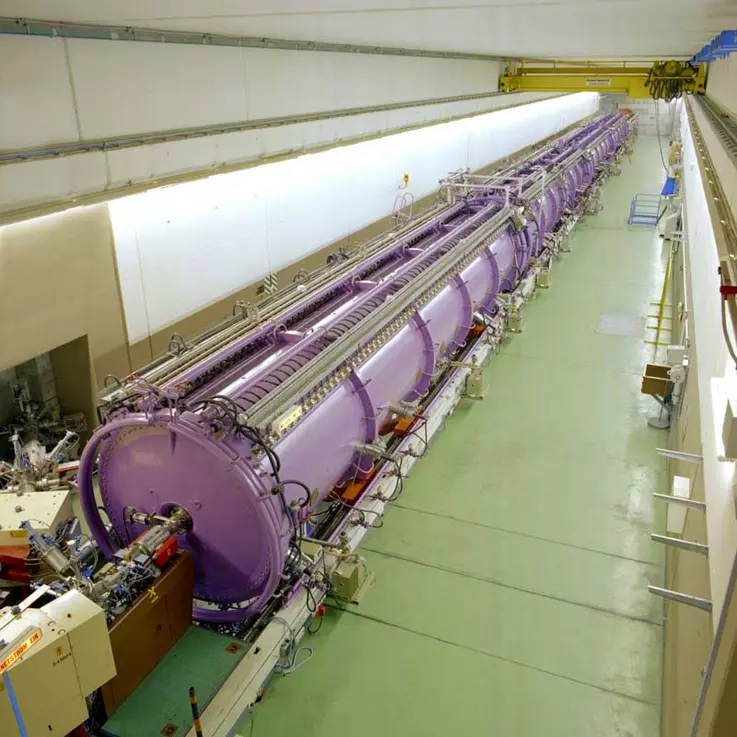
| Linac | Cyclotron | Synchrotron | |
|---|---|---|---|
| How it accelerates | Single-pass RF cavities (linear) | Circular motion with fixed RF frequency | Circular motion with RF acceleration + ramped magnetic field |
| Particle type | Protons/ions & electrons | Protons/ions | Protons/ions & electrons |
| Energy limit | MeV .. GeV+ (length / gradient limited) | ~10 .. 500 MeV (relativistic dephasing) | GeV .. TeV (magnetic field & radius) |
| Key feature | Single-pass acceleration (no recirculation) | Compact, quasi-continuous beam, high duty-cycle | Multi-turn acceleration with energy ramping (ms .. s timescale) |
| Typical uses | Injectors, Free Electron Lasers, medical linacs | Isotope/neutron/muon production, proton therapy | Colliders, light sources, hadron therapy |
| Example | UNILAC (GSI, Darmstadt/DE) | Ring Cyclotron (PSI, Villigen/CH) | LEIR (CERN, Geneva/CH) |
 |
 |
|
Major accelerator types cont'd
| Plasma accelerator | |
|---|---|
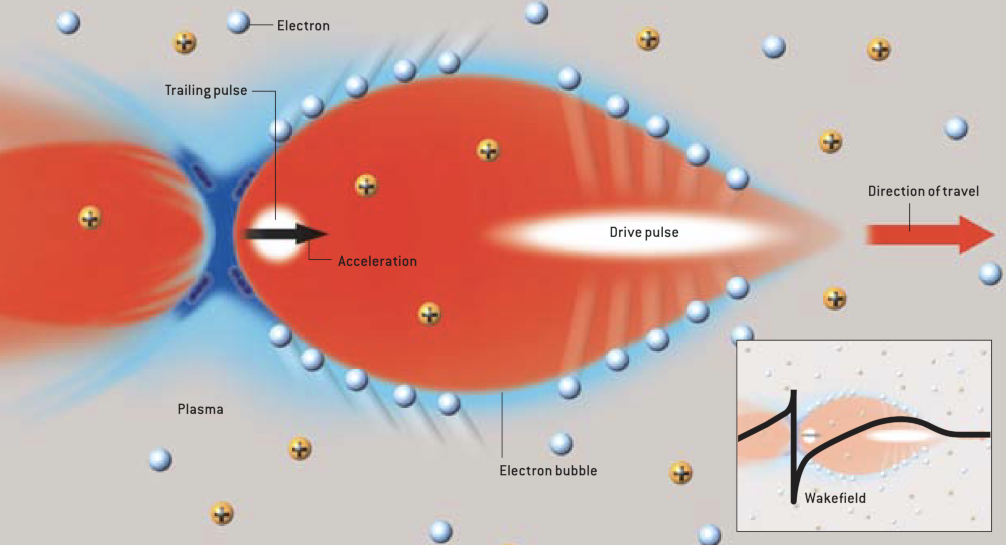
| How it accelerates | Plasma wakefields accelerate injected electrons (linear) |
| Particle type | electrons (primarily) |
| Energy limit | GeV-scale demonstrated (limited by staging & beam quality) |
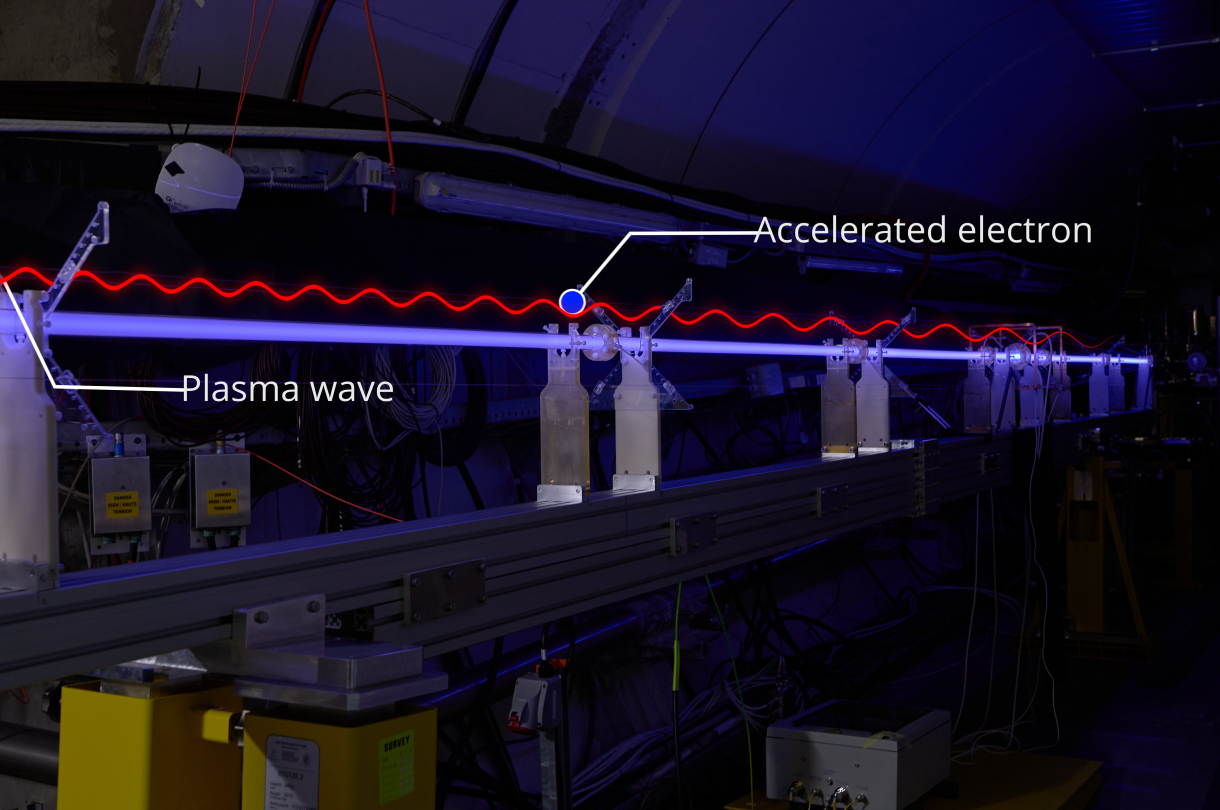
| Key feature | Wakefields driven by lasers or particle beam; extremely high gradients (100 GV/m) → very compact; single-pass acceleration / no recirculation |
| Typical uses | R&D (goals: compact light sources, future colliders, ultrashort bunches) |
| Example | AWAKE (CERN, Geneva/CH) |
  |
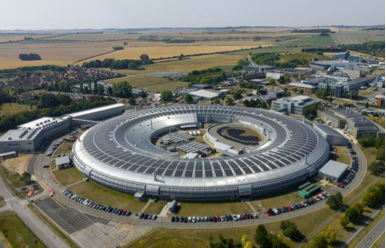
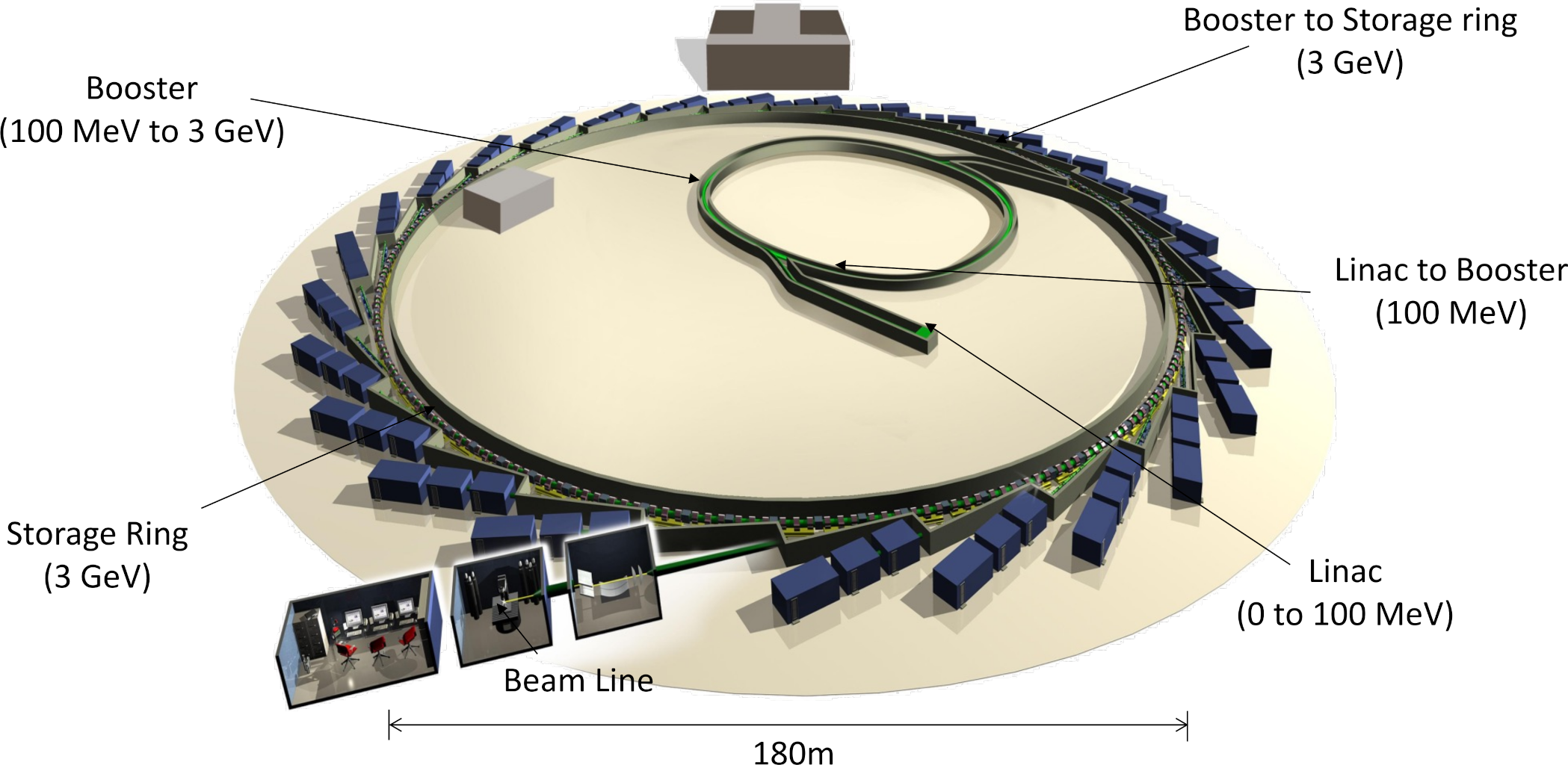
UK Diamond Light Source
Accelerate electrons and store at 3 GeV. Bending = synchrotron radiation
$\leadsto$ highly focused, tunable and intense photon beams
$\implies$ probe atomic structure and material properties (proteins, drugs, batteries, archaeological artifacts, ...)
UK ISIS Neutron and Muon Source
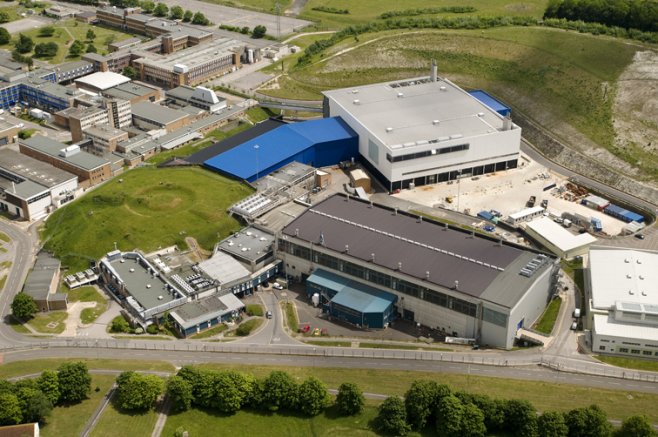
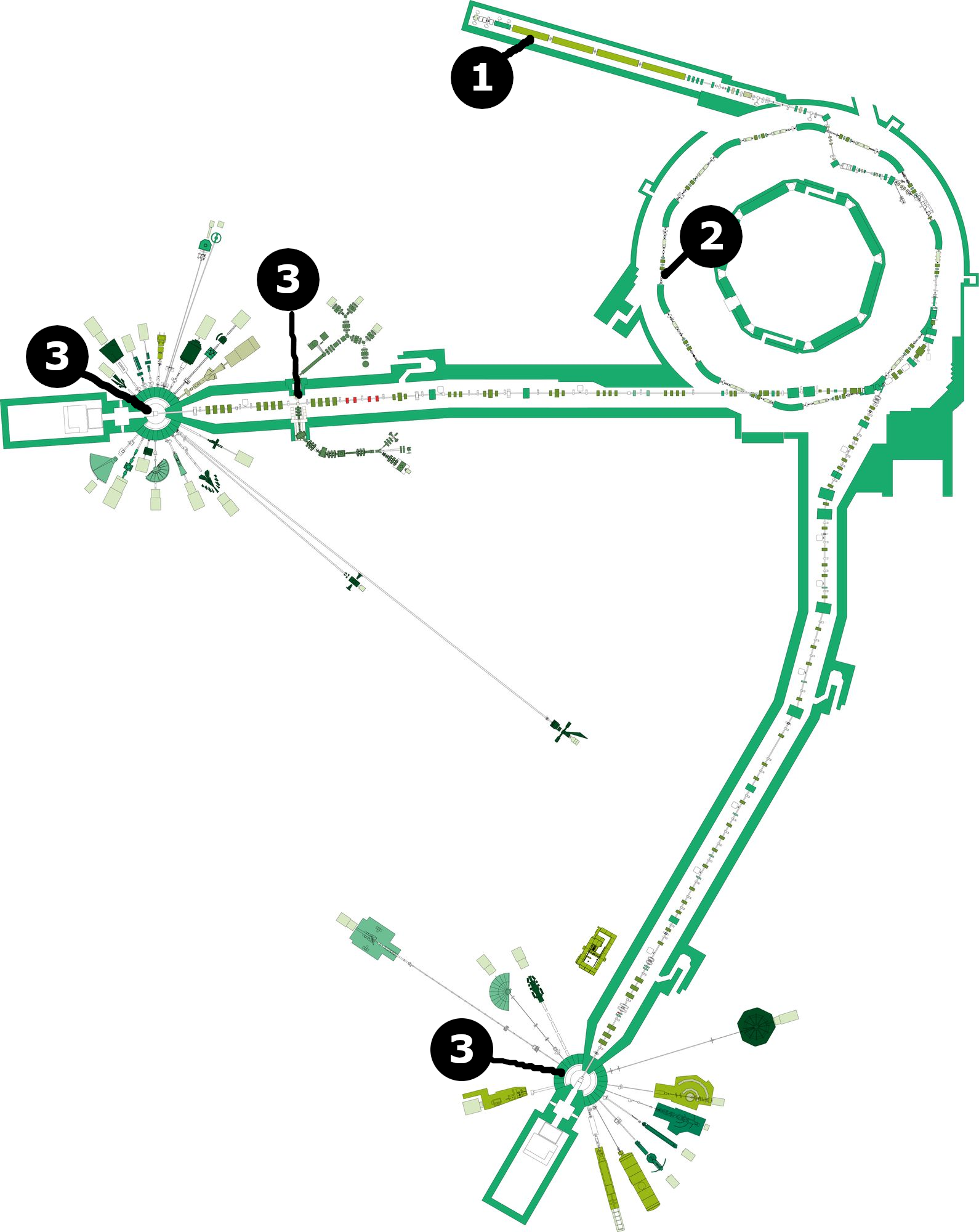
Accelerate protons to 800 MeV at 50 Hz. Impact on heavy-metal target = spallation
$\leadsto$ pulsed neutron and muon beams (time-of-flight measurements)
$\implies$ probe structure and dynamics of materials (quantum materials, superconductors, chemicals, engines, archaeological artifacts, ...)
 (1) proton source and Linac,
 (2) rapid cycling synchrotron,
(3) targets
CERN: European Organization for Nuclear Research
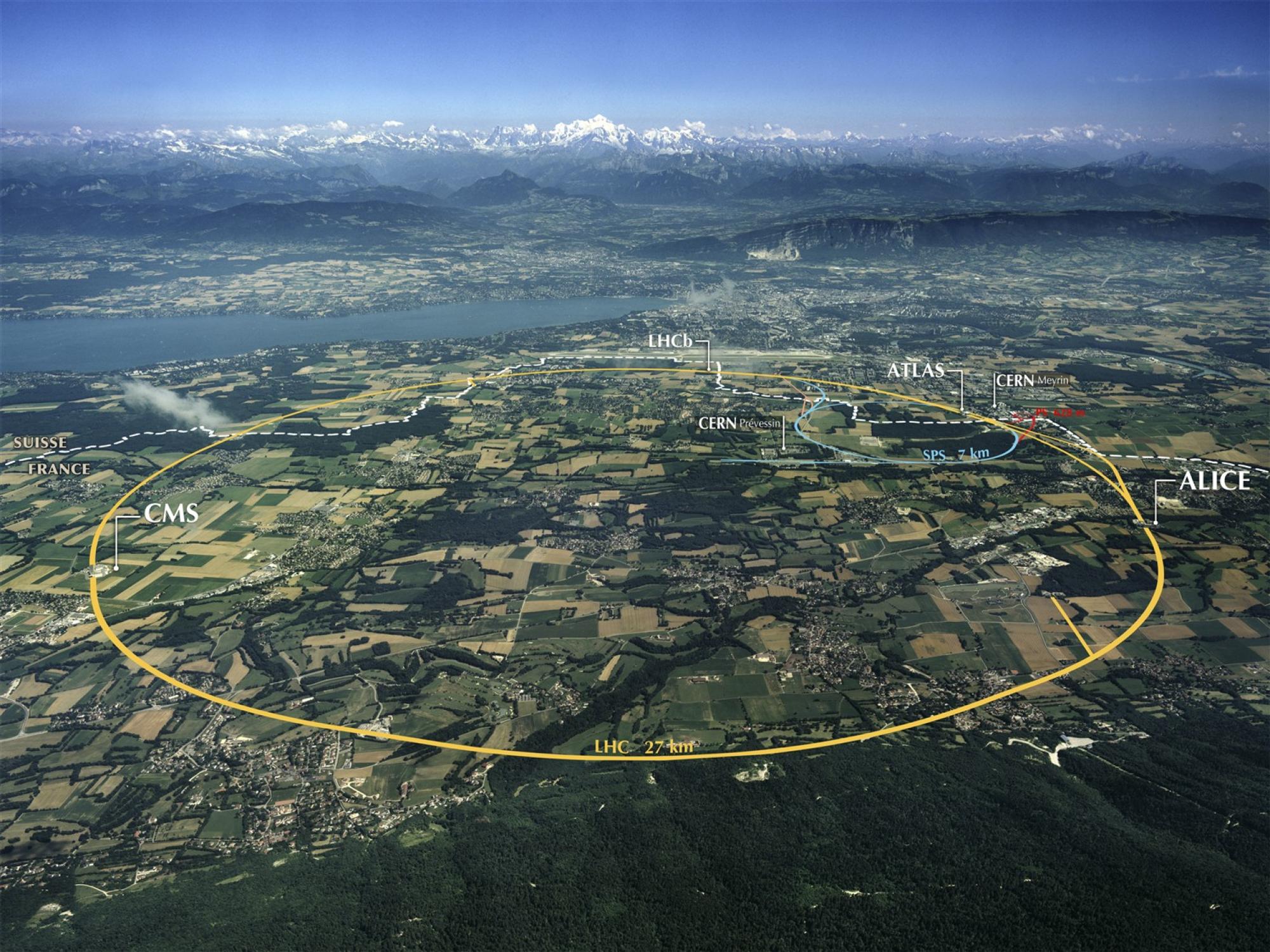
Collide particles at highest possible energies!
$\implies$ probe fundamental structure of matter
CERN accelerator complex
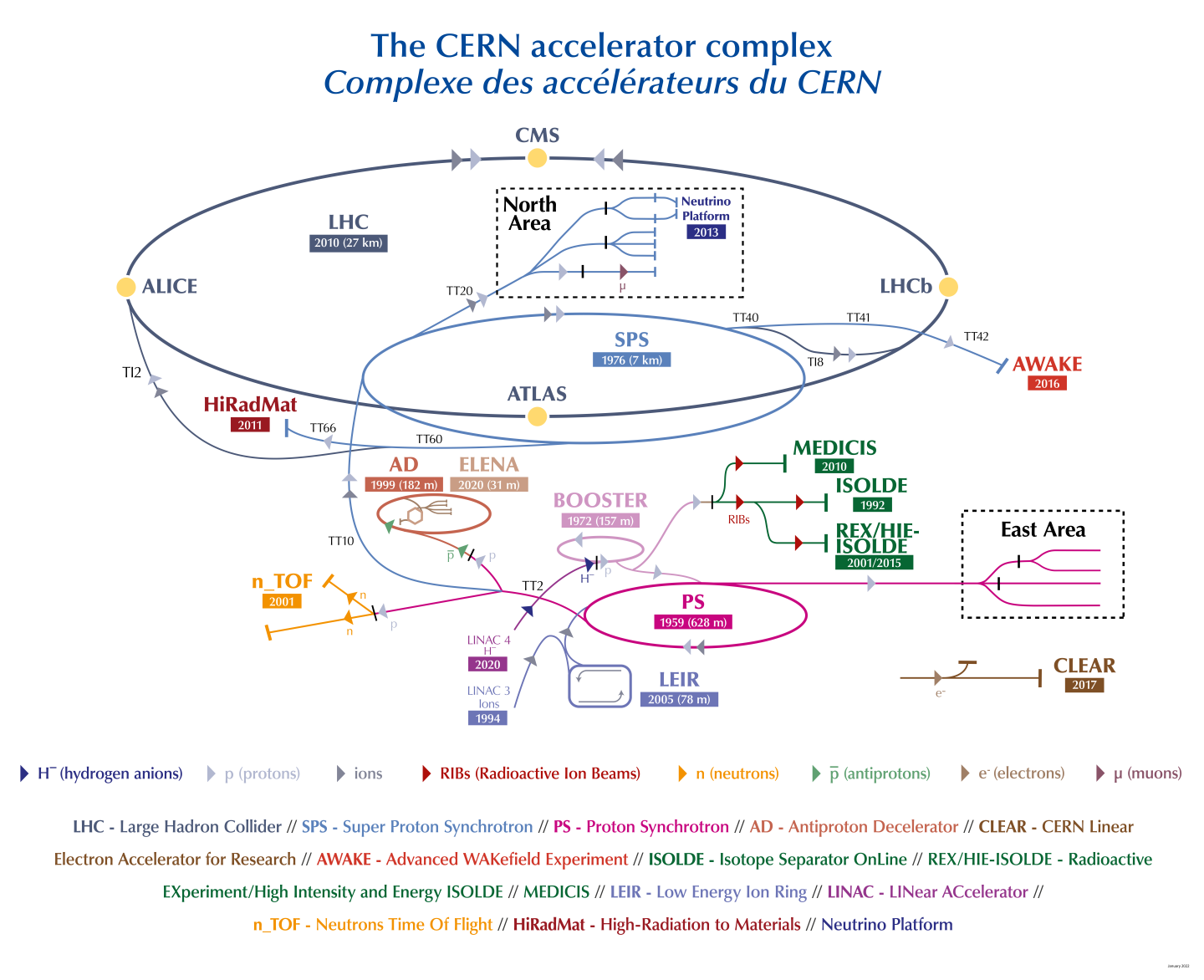
Stepwise acceleration of protons to 7 TeV:
LINAC4 (160 MeV)
$\rightarrow$ Proton Synchrotron Booster (2 GeV)
$\rightarrow$ Proton Synchrotron (26 GeV)
$\rightarrow$ Super Proton Synchrotron (450 GeV)
$\rightarrow$ Large Hadron Collider (7 TeV)
$\implies$ store and collide for typically 10 .. 20h: high-energy physics experiments!
How many protons are in a beam, how many collide?
World-record LHC Fill Duration
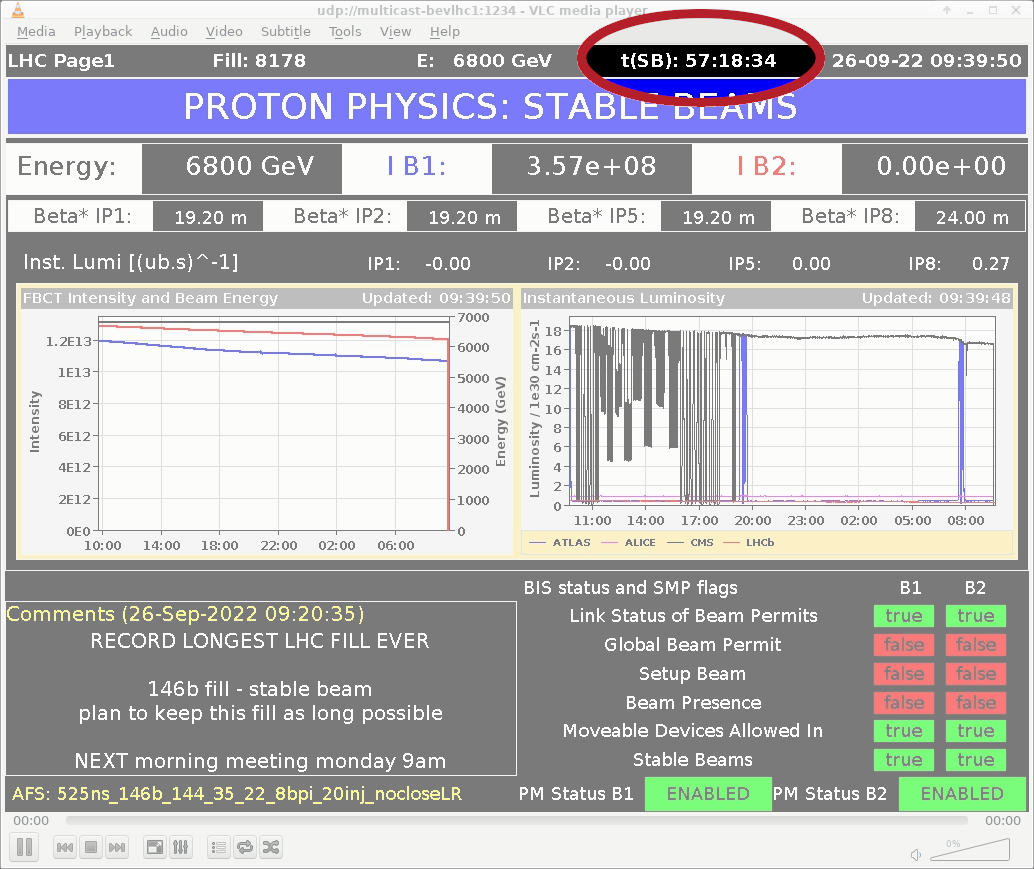
image: CERN LHC OP logbook 2022
$\leadsto$ 57h of beam storage $=$ how many turns in 27 km long LHC?
"%e turns" % (57 * 60 * 60 * c / 27e3)
'2.278423e+09 turns'
Time Scales in a Synchrotron
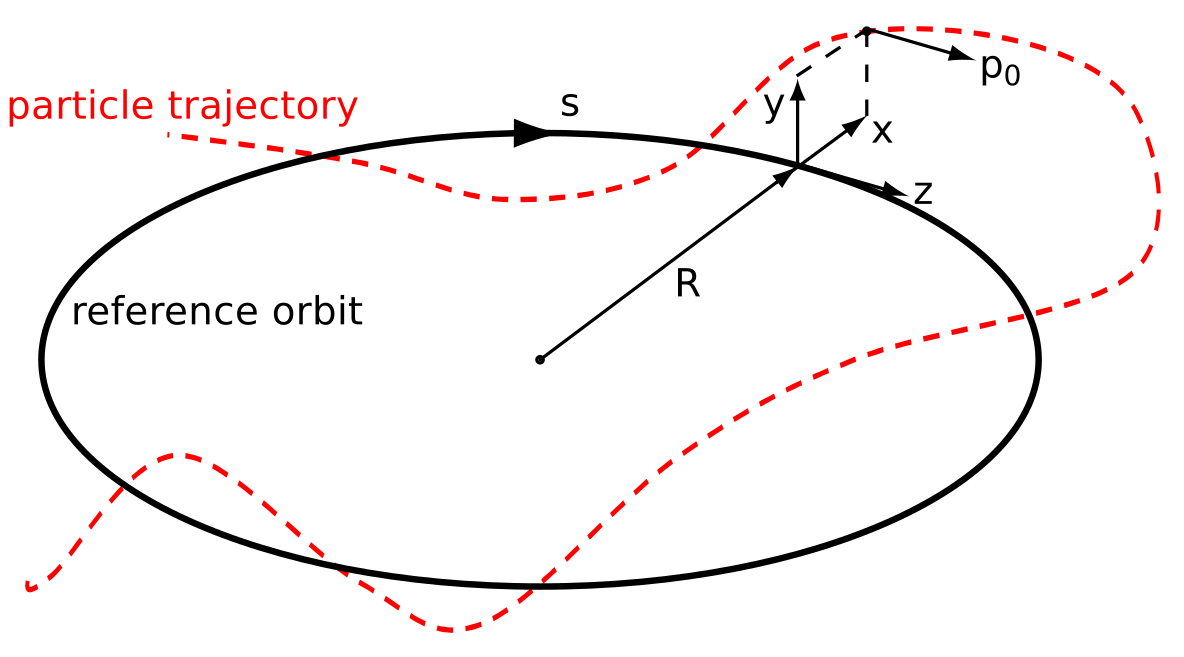
A turn $\sim$ 1..100 μs:
- many per turn: transverse (betatron) oscillations
- once per turn: observation in a wall current monitor
- 100s of turns: longitudinal (synchrotron) oscillations
- 100s of turns: $e$-fold damping time of feedback systems
- 100'000s to $>$ millions of turns: storage times
(compare: stability of the Earth's orbit around the Sun (age: 4.6 bya))
Precise control required!
Study accelerators experimentally, computationally and analytically $=$ accelerator physics!
$\implies$ control and predict stability across these time scales!
$\implies$ learn about required basic concepts in the following lectures! :-)
Summary
- Intro to Accelerators
- similarities to plasma physics, importance of external fields
- rf cavities, dipole and quadrupole magnets
- Accelerator Types
- linear accelerators (linacs)
- cyclotrons
- synchrotrons
- Facilities & Applications
- light sources
- neutron spallation sources
- high-energy physics
- Time Scales